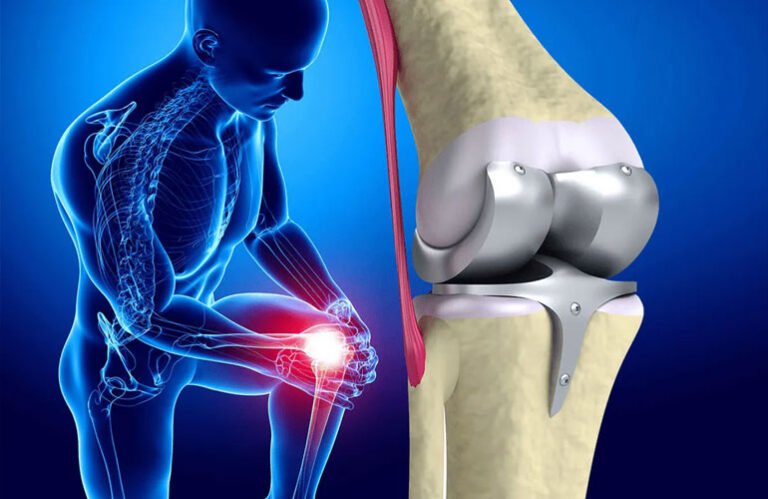
Knee Replacement Surgery is one of the most common and successful operations in orthopaedic practice. Advanced knee arthritis — where cartilage has worn away completely (bone-on-bone) — causes constant pain, deformity and severely restricted walking. Assoc. Prof. Dr. Murat Aydın performs total and robotic knee replacement using the latest implant technology, millimetre-precision planning and a same-day mobilisation protocol.
- What Is Knee Replacement Surgery?
- Who Needs Knee Replacement?
- Symptoms of End-Stage Knee Arthritis
- Non-Surgical Options Before Replacement
- The Operation — What Happens Step by Step
- Recovery Timeline
- UK vs. Turkey — Cost & Waiting Times
- Success Rate & Outcomes
- Frequently Asked Questions
- Get Your Free Quote
1. What Is Knee Replacement Surgery?
Total knee replacement (TKR) involves removing the damaged surfaces of the femur (thighbone), tibia (shinbone) and patella (kneecap), and replacing them with a cobalt-chrome femoral component, a tibial tray and a highly cross-linked polyethylene (XLPE) bearing insert. The result is a smooth, pain-free joint that moves naturally.
In robotic knee replacement, the surgeon uses a 3D CT-based model of your knee anatomy to plan bone cuts with millimetre precision — eliminating guesswork and restoring your natural leg alignment to within ±1 degree.
2. Who Needs Knee Replacement?
Knee replacement is recommended when:
- X-rays confirm bone-on-bone arthritis (no remaining joint space)
- Pain is present at rest and prevents normal daily activities
- Conservative treatment (physiotherapy, injections, PRP) has failed
- There is significant leg deformity (bow-legs or knock-knees)
NHS waiting times for knee replacement can exceed 12–24 months. Many UK patients choose Turkey to receive the same operation within 2–4 weeks.
3. Symptoms of End-Stage Knee Arthritis
- Constant knee pain even on short walks or flat ground
- Bow-legged (varus) or knock-kneed (valgus) deformity worsening over time
- Night pain that wakes you from sleep
- Knee range of motion restricted below 90 degrees
- Inability to climb stairs, get in and out of a car or bath
4. Non-Surgical Options Before Replacement
Before recommending surgery, the following conservative measures are considered:
- Physiotherapy and weight loss: Reducing load on the joint and strengthening surrounding muscles.
- Knee bracing (unloader brace): Offloading the most damaged compartment.
- Hyaluronic acid (viscosupplementation): Lubricating injections to reduce friction and pain.
- PRP (Platelet-Rich Plasma): Biological growth factor injections to slow cartilage degeneration.
- Stem cell therapy (BMAC): Most advanced biological option before joint replacement is required.
In end-stage arthritis with bone-on-bone changes, these measures provide only temporary relief and joint replacement becomes necessary.
5. The Operation — What Happens Step by Step
Duration: 60–90 minutes | Anaesthesia: Spinal (preferred) or general | Hospital stay: 3–5 nights
- Pre-operative planning: 3D CT scan for robotic templating of your individual anatomy.
- Incision: A single incision over the front of the knee (10–15cm).
- Bone preparation: Robotic-guided precision cuts remove the damaged bone surfaces.
- Component placement: Femoral component, tibial tray and XLPE insert trialled and cemented in place.
- Wound closure: Absorbable sutures and waterproof dressing. Drain removed after 24 hours.
You will be sitting up and moving your knee within hours of surgery. A physiotherapist will begin standing and walking exercises the following morning.
6. Recovery Timeline
- Day 1 after surgery: Sitting up, first physiotherapy session, walking with a frame.
- Days 2–3: Walking independently in the ward, stairs training.
- Days 4–5: Discharged from hospital to hotel. UK patients typically fly home at day 5–7.
- Weeks 2–4: Walking without a frame indoors. Stitches or clips removed at 12–14 days.
- Weeks 4–6: Driving a car (left knee only or automatic). Comfortable walking outdoors.
- 3 months: Full daily activities, most patients describe complete pain relief and natural movement.
7. UK vs. Turkey — Cost & Waiting Times
NHS / UK Private
- NHS wait: 12–24+ months
- Private cost: £12,000–£18,000
- Follow-up: NHS GP
Turkey (Dr. Aydın)
- Treatment within: 2–4 weeks
- Significant cost savings
- UK GP liaison letter included
* UK costs are market estimates. Contact us for your all-inclusive Turkey quote.
8. Success Rate & Outcomes
Total knee replacement has one of the highest success rates in all of surgery: 96–99% implant survival at 25 years with modern components and surgical technique.
Over 95% of patients describe complete or near-complete resolution of their pre-operative pain. Functional outcome is measured by independent walking distance, stair climbing ability and return to leisure activities — all typically achieving full restoration by 3 months.
Frequently Asked Questions
How long do I need to stay in Turkey for knee replacement?
Is it safe to fly after knee replacement?
How much does knee replacement cost in Turkey?
What implant brand is used?
Get Your Free Assessment for Knee Replacement Surgery in Turkey
Send your MRI or X-ray via WhatsApp and receive a personalised treatment plan and all-inclusive quote from our English-speaking team within 24 hours.
Also see: Turkish version of this guide | All treatment guides | Why choose Turkey?